



AI your people actually use.
We find the manual work costing your business time, build the right AI systems around your team's real workflows, and measure adoption after launch.
- Custom systems
- Client-owned infrastructure
70% of AI transformation work is people and processes.
Put people at the centre and AI compounds. The businesses that design around their teams pull ahead, and stay there.
The other 20% is technology and data. Just 10% is the algorithms, and that is where most providers spend their energy.
BCG, The Leader's Guide to Transforming with AISo we design for the 70%.
01We interview the people who will live with the system.
02We design around their workflows, not against them.
03We train your team properly, not once at go-live.
04We measure adoption, not just delivery.
Clarity before commitment. People before technology.
Five services to support your business wherever it is on its AI journey. Open any one for what it is, what you receive, who it suits, and how the work runs.
What it is
We map your workflows, systems and the people doing the work, then rank initiatives by impact, feasibility and adoption readiness.
What you get
- Prioritised roadmap: what to investigate first, and why.
- Executive presentation: the findings and the trade-offs.
- People Readiness Map: champions, resistance, training needs.
- First initiative scoped: the top opportunity made concrete.
Who it suits
- Scaling friction, and no prioritised AI plan yet.
- You want evidence before committing to a build.
- Leadership needs people and workflows weighed, not only technology.
How it runs
- Confirm the operating context
- Map the work
- Interview the people
- Assess impact, feasibility and adoption readiness
- Prioritise and present
Deliverables, responsibilities and boundaries, agreed in writing up front.
IllustrativeHow the roadmap ranks opportunities: impact against feasibility, with adoption readiness as the third axis. What it is
We define what an initiative needs technically, commercially and for the people using it, with the assumptions and risks visible.
What you get
- Technical scope: architecture, integrations, effort, risks.
- Commercial scope: build and running-cost assumptions, and what moves them.
- Human scope: affected roles, workflow change, training load.
- Go, revise or no-go: the decision, and the reasons for it.
Who it suits
- You know the initiative and need confidence before committing.
- A vendor quote leaves assumptions unclear.
- The workflow changes, so adoption cannot be assumed.
How it runs
- Confirm the initiative and open questions
- Map current and future workflow
- Define the technical approach
- Model commercial and human implications
- Recommend go, revise or stop
Deliverables, responsibilities and boundaries, agreed in writing up front.
IllustrativeThe five steps of a scoping engagement, from interviewing the people who do the work to a recommendation that hands over the system design, the comparison of off-the-shelf against bespoke, and an estimate ready to act on. What it is
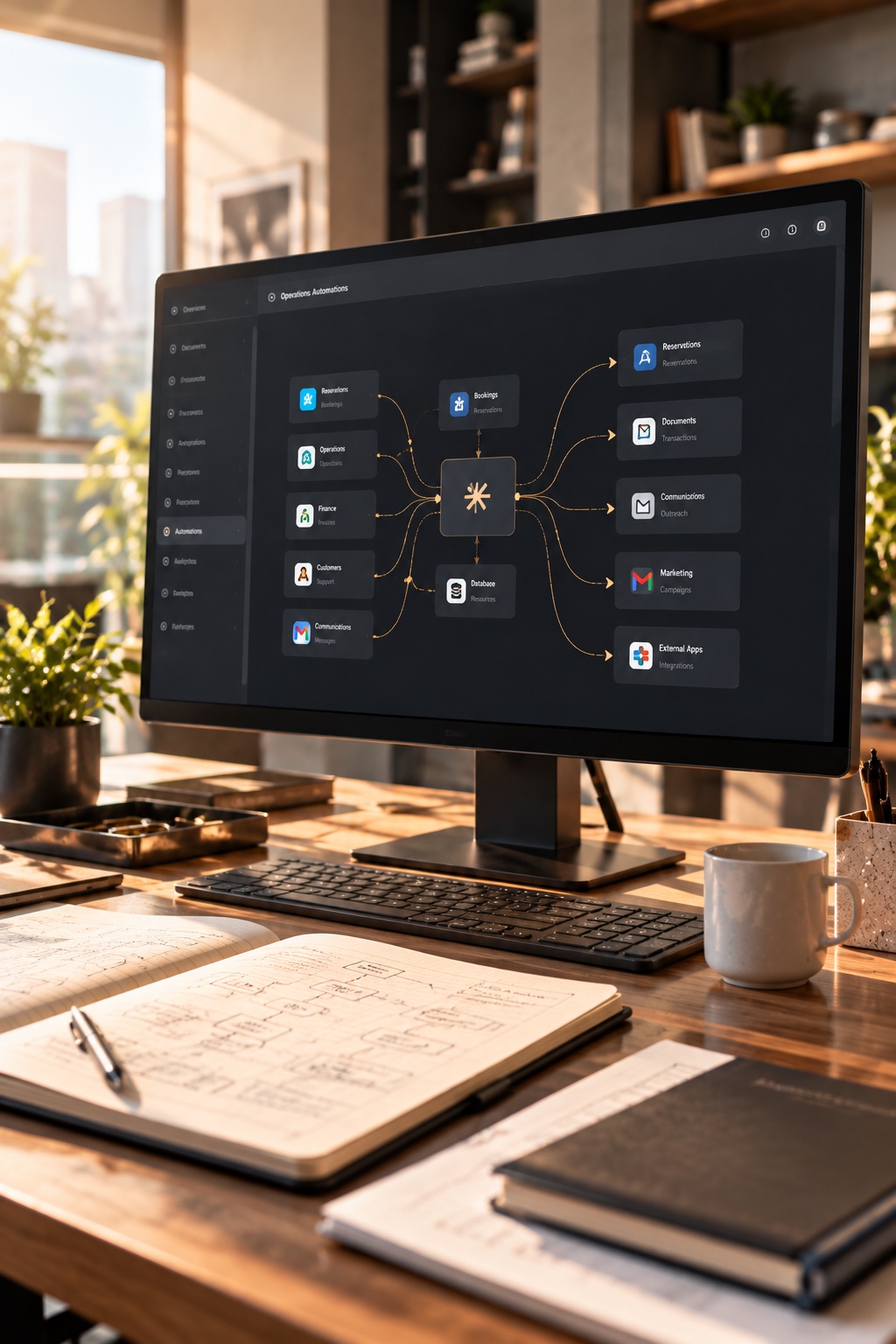
We build automations, agent workflows, pipelines, dashboards, integrations and custom AI applications, designed with the people who use them.
What you get
- Working system: the agreed automation or application.
- Redesigned workflow: shaped with the people who run it.
- Adoption instrumentation: usage signals made visible.
- Documentation and ownership: boundaries and handover assets.
Who it suits
- The opportunity and desired outcome are already clear.
- It must fit an existing team, workflow and tools.
- Usage and ownership designed in, not assumed.
How it runs
- Confirm scope and acceptance criteria
- Design the workflow with users
- Prototype at checkpoints
- Build and verify against the scope
- Land the system with the team
- Observe adoption
Scope, timeline and deliverables are confirmed in writing before work begins.
IllustrativeThe five steps of a build, from interviews with the people who do the work to the gates and measures the system is judged on. What those measures show drives small iterations, not a restart. What it is
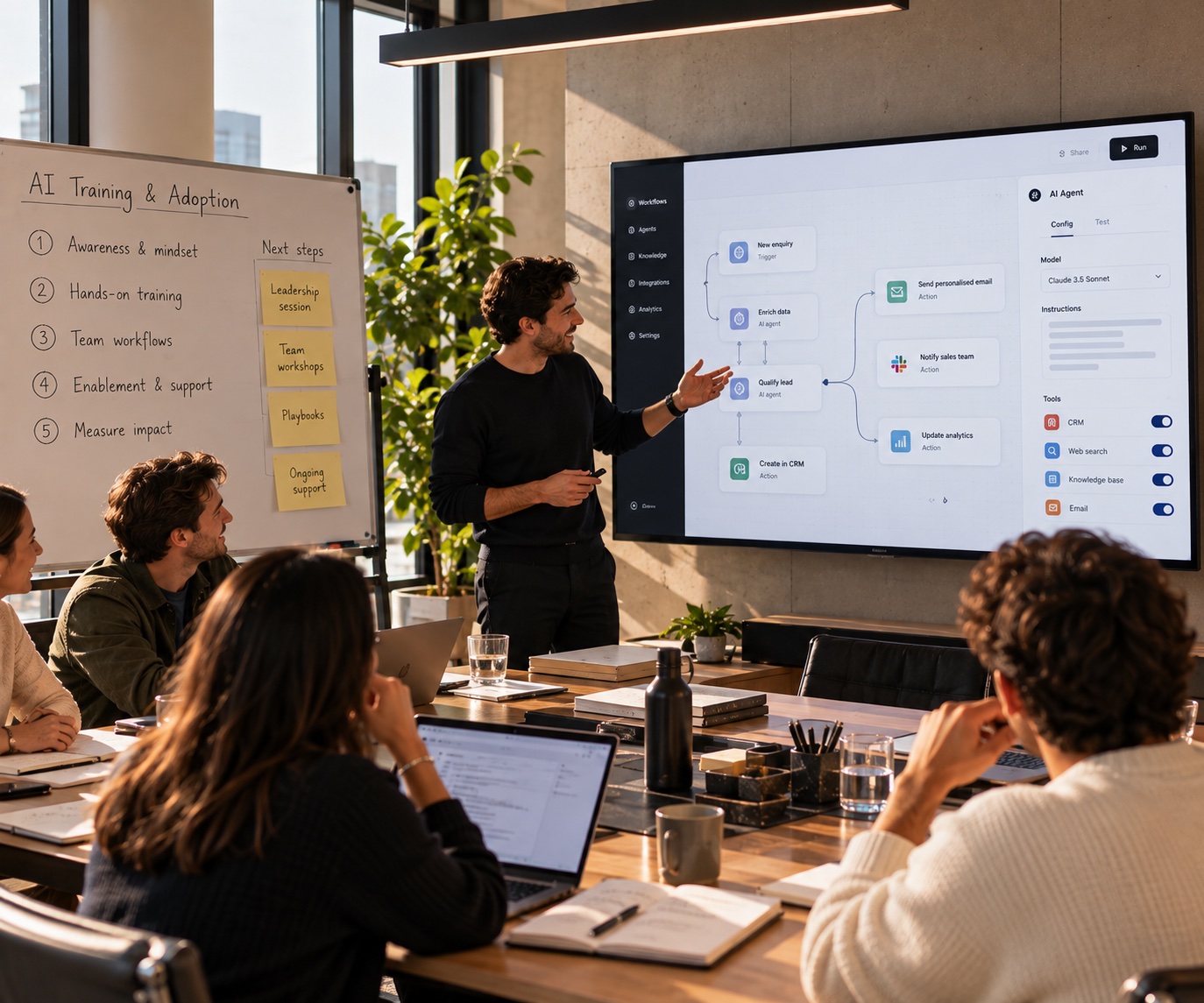
We build role-specific learning around the work your team actually does, covering responsible use and the tools you already run.
What you get
- Role-specific learning: from responsible foundations to daily use.
- Leadership alignment: sponsorship and protected time to practise.
- Champions network: internal advocates who keep momentum.
- 90-day reinforcement: usage reviews, refreshers, unblocking.
Who it suits
- The tools are in place and use needs to become normal.
- Leadership wants adoption to keep going after the initial learning.
- A larger build is coming and you want the team ready.
How it runs
- Awareness: why the change matters
- Desire: AI connected to each role
- Knowledge: tool and workflow patterns
- Ability: practise real tasks with support
- Reinforcement: reviews and unblocking over 90 days
The goal is capability inside your team, not dependence on outside support.
IllustrativeThe 90-day reinforcement loop that follows the initial learning, rather than a single workshop. What it is
We bring the knowledge, tools, automations and agents your team relies on into one governed way of working.
What you get
- Shared approved context: processes and material AI may use.
- Connected agents and automations: linked to that context.
- Controlled infrastructure: limits on what AI can access and do.
- Team ownership: documentation, training and handover.
Who it suits
- AI tools and one-off builds are scattered.
- One controlled way to connect context and tools.
Needs in place: AI in use, approved knowledge, named people.
How it runs
- Inventory what belongs in scope
- Structure how context and capabilities connect
- Document the access boundaries
- Prepare documentation and ownership
- Launch and observe usage
- Hand over and improve
What the layer covers and what ownership includes is set in writing.
IllustrativeConceptual view of the operating layer: approved knowledge, connected tools and agents inside infrastructure you control.
The people-first delivery standard.
Four commitments that hold on every engagement, whichever stage you start at. Each one names the service the practice belongs to.
Listen to the work
AI Opportunity Assessment
We interview the people who run the workflow, not only the people who manage it.
Adoption-readiness interviews run in every assessment, and they surface the tools people already rely on quietly.
Design the future workflow together
AI Systems Development
End users shape the process and review prototypes at defined checkpoints.
End-user sign-off at those checkpoints is an acceptance criterion on the build, not a courtesy review.
Build capability as the system lands
AI Training and Adoption
Training and handover are part of delivery, not an afterthought.
Role-specific programmes and a champions network run alongside delivery, so momentum has owners after we leave.
Measure adoption, not just launch
AI Systems Development
Usage and blockers are made visible after go-live.
Usage analytics are defined at scoping and dashboarded at go-live, then reviewed through a 90-day loop.
Published client work.
Two engagements written up end to end, with the before, the after and the architecture in full.
- AI Opportunity Assessment
MyPowerRenewable energy
12 initiatives prioritised, from 29 identified across the business
Senior team time was absorbed by manual, repetitive work, with no shared AI strategy in place.
Read the case studyIllustrativeThe phased roadmap published in the case study, redrawn: the twelve prioritised initiatives sequenced into three categories against a 0 to 18 month scale, four Quick Wins at 0 to 3 months, five Foundation Builders at 3 to 9 months and three Strategic Bets at 9 to 18 months, scored on impact, complexity and time to impact. No individual initiative is named, dated or scored. - AI Opportunity Assessment
QCR RecyclingWaste and recycling
10 initiatives prioritised, from 14 surfaced across the business
Manual processes had grown alongside the business at every level, with no shared view of where AI fit or in what order.
Read the case studyIllustrativeThe phased roadmap published in the case study, redrawn: the ten prioritised initiatives sequenced into three categories against a 0 to 18 month scale, three Quick Wins at 0 to 3 months, three Foundation Builders at 3 to 9 months and four Strategic Bets at 9 to 18 months, scored on impact, confidence and effort. No individual initiative is named, dated or scored.
Selected engagements
Delivered work without a published case study.
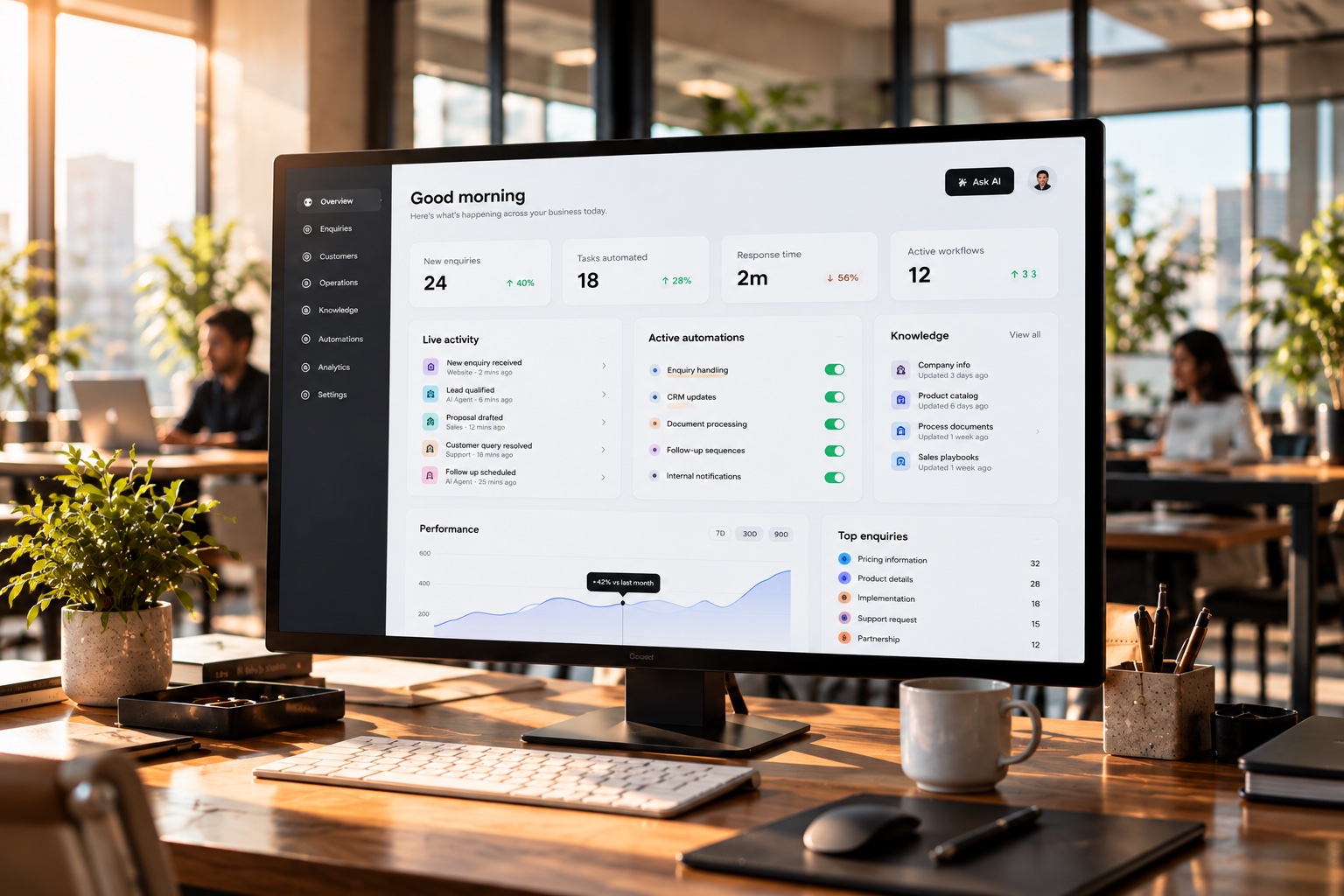
- NeighbourgoodHospitalityAI Systems DevelopmentGuest enquiries answered around the clock
- MyPowerRenewable energyTraining and AdoptionThe whole team trained in one seminar programme
Ready to give your team their time back?
No obligation and no pitch. We diagnose before we implement.
How the 45 minutes goes
25 minHow your business runs today
The bulk of the call. We work through your operations and where the bottlenecks actually sit.
15 minWhere AI genuinely fits
We map what you have told us against what AI reliably does well.
5 minWhat happens next
An honest recommendation on a good place to start, and what it would take.
Pick a slot and your calendar invite arrives straight away. Prefer email? Write to daryon@birdsaiperspective.com.
Still weighing it up.
- Where should we start if we are unsure what to build?
With the AI Opportunity Assessment. It is a structured diagnostic of your workflows, your systems and the people doing the work, and it ends with a roadmap ranked by impact, feasibility and adoption readiness.
Your top opportunity comes back partially scoped, so the path to a build is concrete rather than a wish list.
- Can we begin with one specific initiative?
Yes. Digital Solution Scoping takes an initiative you already have in mind and defines it in three parts: the technical scope, the commercial scope, and the human scope covering who is affected and how their workflows change. It ends with a clear recommendation, including an honest no-go when that is the right answer.
- Do you build the system as well as advise on it?
Yes. AI Systems Development covers automations and agent workflows, data pipelines, dashboards, integrations and custom AI apps. Scope, timeline and deliverables are confirmed in writing before work begins.
- How do you involve the people who will use it?
We interview the people who run the workflow, not only the people who manage it, and we map the future workflow with them rather than for them.
End users review prototypes at defined checkpoints and their sign-off is an acceptance criterion. Training runs as the system lands, and usage is measured after go-live.
- Who owns the finished system?
You do. Systems are documented and handed to your team to run and extend, on infrastructure you control. On the MyPower engagement both tools were migrated to the client's own Copilot tenant and Streamlit account, along with the repository for the generator.